In the world of marketing, there are two types of brands – leader brands and challenger brands. Leader brands are those brands who often command the largest market share or value. They mostly have a first mover advantage or are early entrants in the category. They have deep pockets and often act like a bully. Challenger brands are new entrants in the category who have the ability to change the game as the stakes are relatively lower compared to a leader brand. They can either belong to the same category or come from a different one to create a disruption in the category. A classic example is what Apple did to Sony Walkman with iPod.

However, in some cases a leader brand can also become a challenger brand. It ise not complacent with its success. The brand constantly keeps innovating and raises the bar for the competition. Some brands that follow this are Apple, Amazon, Facebook.

One such Indian brand that seems to fit this is Tata Sky. Even though this brand had the first mover advantage in the DTH category it keeps introducing new and innovative offerings at regular intervals. This offerings are often industry firsts where other players like Airtel, Videocon, Reliance have no choice but to copy and make it available to their customers

Tata Sky has launched many firsts in the DTH space. Some firsts, according to my guess, include Interactive TV with ActivZone like games, education, movies, cooking, darshan etc; pause and record live TV feature; HD channels; pay per view movie; recording on the go and the latest of all is a Tata Sky Mobile Access App.

Available free on the iPhone, iPad and iPod Touch this app allows you to see what your facebook friends are watching, set reminders for your favorite shows, use your phone to control the TV, discover the most-watched and highest-rated shows and much more. This is currently the number one app on the Indian app store.

I do not know about their services as I am not their customer yet (using CAS offered by cablewala), but if at all I am going to switch to DTH, it is certainly going to be Tata Sky.

I only hope they stay true to their promise of ‘Isko laga dala toh life jingalala’

IPL 3 season is on and if you have seen even one match (I’m sure it is more than one) you would be surprised to see some new ad formats. Micromax during strategic timeout, Karbonn mobile in a middle of an over and Kingfisher at the time of Third Umpire are just some of the new ad formats that would have caught your attention. According to me, the one that stands out (or should I say stands up) is the MRF blimp hovering in the air.

Each time the camera focuses on the MRP blimp you just cannot miss it. In fact the blimp also gets a mention by the commentators. The best part about this MRF blimp is that it is clutter free, non-intrusive and non-irritating (like most of the other TV commercials). It is a first of its kind format and it seems to have caught the attention of the other marketers as well. Vodafone too has created its own blimp (they call it airship) and have a contest where the winner gets a chance to fly in it. http://is.gd/bDanR

Volkswagen has used this medium recently to the launch its Beetle. http://is.gd/bDakl

Tata Photon took to skies to promote their Tata Photon Plus mobile broadband service in Bangalore http://is.gd/bDalG.


IKEA too has interesting campaign where we see furniture falling from the sky in the middle of a street.


Welcome to the world of ‘air’vertising. Although this medium has not been used extensively, this one is sure to grab the advertiser’s interest and consumers eyeballs. I am sure we will see more use of ‘air’vertising by the marketers in the near future as the format is new, unconventional, clutter free and effective. Airships, Blimps, Air Balloons, Sky Banners are just some of the ‘air’vertising options which can be used by the brands in their campaign.

So next time when the campaign is on air…we know where to look.

Every time I look at the top 100 global brand list (http://bit.ly/rqrH) it makes me wonder why not a single Indian brand features in the list. What are the reasons that Indian brands fail to make the cut? Are Indian products below global standards? Is it because Indian companies lack technical expertise to make such products?? Or does the Indian consumer mindset act as a roadblock?

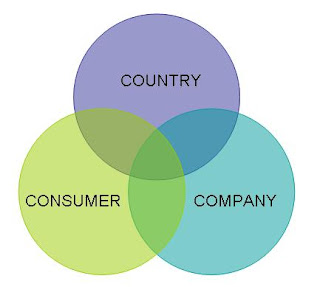
I think it is difficult to single out one key reason why Indian brands do not fare well on the global map. Superior product quality is one main ingredient missing in our Indian brands (http://bit.ly/a2A0n). Besides this, I see three 'CO' reasons which explains why Indian brands fail to become world class brands.

1) ‘CO’UNTRY’S IMAGE - Remember the simple math equation we studied in school - A = B and B = C hence A = C. Well, this equation also holds true when we talk about country's image impacting the local company’s image and in turn affecting the product image of the company. (Country’s image = Company’s image = Product’s image)

The values, beliefs and image of the country play an important role in shaping the success for the brands of the local companies of that country. Switzerland is the best example to explain this.

Switzerland as a country stands for high quality, precision, class, innovation and aspiration. These same qualities are reflected in their brands. Brands like Rolex, Swatch, Swiss Army Knife are world class brands not only because these are great products, but the country's image lends its credibility and values to these brand to make it a truly world class brand.

Other countries like US, Japan and Germany are fine examples where the countries values are ingrained in the brands.

When we talk about India, corruption, poverty, world’s back-office and Incredible India are some of the attributes get associated with our country. One marketing campaign (Incredible India) is not going to be enough to correct the image of our county. These strong negative connotations have severely tarnished the image of the country. Due to this, no matter how well our Indian companies try hard to make a global brand, the fact that it is ‘Made in India’ will always act as a dampener. Would you wear a Levis or a Rolex or Gucci if it was made in India?

2) ‘CO’MPANY’S FOCUS

At first we Indians drove Fiat than came the era of Maruti Suzuki and now we have Nano, the world’s cheapest car. This sums up the underlying philosophy of the Indian companies and the Indian market. Indian companies make products which are affordable, durable and most importantly, which satisfies the basic utility of the product. Making aspirational products which has top class design and style is still not the focus of the Indian companies. Is the Indian consumer market driving our Indian companies to make such products or are the Indian companies forcing the Indian consumers to accept such products? It is a typical chicken and the egg problem of which comes first.

Today, where MNCs have entered the Indian shores, Indian companies like Reliance, TATA, Godrej, Videocon, Bajaj are feeling the heat and fighting a losing battle when it comes to brands. These Indian companies have large market capitalization but small market share and even smaller brand equity compared to foreign brands across consumer categories.

3) ‘CO’NSUMER PSYCHE

Indian consumers purchase habits can be aptly summed in three words. ‘More (quantity) for Less’. Indian consumers crave for more quantity at the same price, preferably at the lesser price. Indian consumers are value conscious customers. Value for money is the most important proposition for the Indian consumers. Brands are still looked upon as products and quantity is still the king for an average Indian consumer. This psyche will be seen across the country be it metros or small towns. Maruti, Lifebouy, Rin are not the best brands in their categories but they are leading brands in the country working on the price proposition.

Bottom-line is will India ever have a brand which will be called a World Class brand? A brand which will be used by consumers across the globe? A brand which will be in the same league as Disney, Apple, Google, Toyota etc?

Do you think India can have such a brand? or Does India already have such a brand which can be called a global brand? Do share your thoughts.

We wake up to our Nokia Phones, paste our teeth with Colgate, eat Kellogg’s for breakfast, wear Arrow shirt and Blackberry trousers, drive Honda City to work, work on a Dell laptop, order lunch from Subway, visit Facebook to stay connected with friends, dinner at McDonalds, ice cream at Gelato and end a day with ‘Good Night’.

It is interesting to see that foreign brands have become such an integral part of our everyday lives that we Indians (knowingly or unknowingly) wear, use, talk, eat, drink (may be swear) foreign brands day in and day out. The only thing left Indian in us is our Indian name. Nothing wrong in using foreign brands, but what is disheartening to see is that Indian companies fail to give us these aspirational brands.

Is this true or a myth. To just validate this, I did a quick survey among my friends / colleagues on brand they would like to use in few consumer categories, if money was not a constraint. I am sure you will endorse this list as well.

Q: If you were given a choice which is the brand you would want to buy and use in each of the product categories. You may have already bought the brand and currently using it. It can be Indian or international brand. Also, please do not mention luxurious and overtly expensive brands. Eg: Porsche or Ferrari when it comes to cars. Answer should be Honda City, Ascent, BMW, Mercedes etc.

There you go, the list speaks for itself. But what this list does is it raises few interesting questions from the branding perspective.

- Are foreign brands really superior in their quality than Indian brands?
- Do Indians lack trust and confidence in Indian brands?
- Do Indian companies give priority to profits over brand building?
- Is the image of our country driving people away to adopt Indian brands?

Will try to answer these questions in my next post. Meanwhile, do share your thoughts.

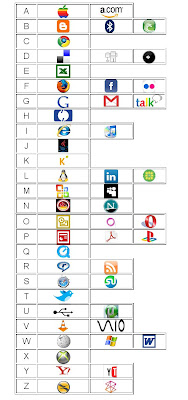
Today, technology is an integral part of our lives. The way technology is shaping our lives; the day is not far when our school textbooks will have its own technology dictionary. :-) So, what will our technology dictionary look like? This is a small attempt to make a technology dictionary from A to Z. The dictionary is in a form of a quiz.

So, how many technology brands can you recall? If you recall every brand then you are certainly a geek. :-)

(Click here to zoom)

Note: There were some alphabets which had more than three brands. Eg: W – Word press. But I have refrained from adding more than three brands for each alphabet.

If you want the answers or have suggestions, just drop in a mail at
sagar.sha@gmail.com or a Tweet @sagsha

Disclaimer: The logos used are only for representative purposes. Not for commercial purposes. Please don’t sue me.

Something to put smiles back to our gloomy mood. How do Company Logos look like in recession times?


For More: check out the here.

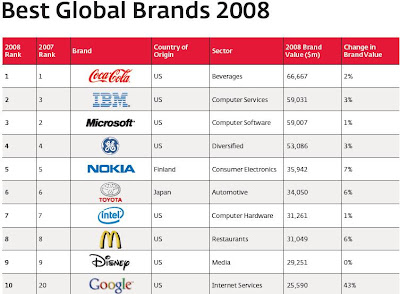
Interbrand and Businessweek releases the Best Global Brands report every year. This year too they have published the report on the world’s most valuable brands. If we look at the table very closely, we can learn a lot of things about these global brands.

See Complete Table Here

Some interesting findings:

  • All the brands are consumer brands which are directly bought, used and consumed by the consumers. Only a handful of brands are B2B brands.

  • These global brands are truly global, in the sense that they are known across the globe, even if they are not present in that country. For instance, everyone knows about Starbucks in India even tough it does not have its shop in India.

  • Every global brand is a leader (or next to leader) in their respective category in their home market. Some in the International markets as well.

  • These global brands have powerful brand recall. They generate top of mind recall in their respective category.

  • Automotive, Financial Services and Consumer Electronics are top three categories that dominate the global brand list.
  • It takes a lot of time to build a global brand. However, there isn’t a magic number on the number of years it takes to build a global brand. The best example is Google which is just a 10 year old brand whereas Coco Cola is 122 year old brand.

  • Only three nations, United States and Europe and Asia rule the Top 100 Global Brand list.

  • United States clearly dominates the list where one is every two brand comes from this country. Infact, 8 out of top 10 global brands belong to US.

  • European countries like Italy, France and Switzerland capture the other half of the global brand list.

  • Only two Asia countries Japan and South Korea feature in the list.

I leave this post with an important question; “Will India ever have a Global Brand?”

Today, the word ‘Brand’ has become a generic term for ‘Products’. The old adage of ‘People no longer buy products but buy brands’ could not have been more true than our present times. Just take for instance, iPod. If you want to buy an MP3 player it has got to be an iPod, right?

Now, let’s say you enter an electronics store to buy an iPod. The salesman shows you an iPod look-alike Mp3 player with same features, same colour options and same accessories to that of an iPod. In fact, he will also give you a reasonable discount on it. The only catch is, it does not have an Apple logo on it and it does say it is an Apple product. Will you buy it? Chances are you won’t. That my friend is the ‘Power of Branding’.

So what is branding? Is it just the name or a logo of a product? Or is it advertising or selling products in a different way? There is no clear cut definition of the term brand or branding. Many authors and brand experts have different way describing the term and each definition looks correct if we look in its context. (This is what I like about marketing! Interpret the way you want.)

According to me, Brand(ing) is all about creating an experience, an aspiration, an emotional connect and a sense of belonging for the consumers with the product or service. Brands should stand for their values and deliver consistently on their promise.


Coca Cola is more than 150 year old young brand. Three ex-CEOs of the company are no more but this brand still lives on and is the number one soft drink across the globe. Just think about it, the company sells just ONE COLA DRINK and it is the number one brand in the world. So what does Coca Cola do differently from another other cola brands? Why is Coca Cola a world class brand? Is it the best cola drink in the world? Certainly not. But what it does with its brand is certainly the best among its competitors.

I think to make a world class brand a company needs to have few ingredients. These ingredients are essentially what existing global brands display and what the brand manager should keep in mind to take make his brand a world class brand.


Brand speaks for itself…

This is by far the most important factor for any brand. If the brand does not deliver on the functional attribute, it will not succeed even if you pump in millions of dollar on branding and communication. In fact, if the functional feature of your brand is unique, powerful and simple then I believe that half of your job is done.


Brands like Apple, Google, Amazon, Toyota and Sony are leaders in their product categories because their products are so cutting edge and at the same time so simple to use that the customers turn into fans and they become the spokesperson for the brand.

What’s in a Name…

‘Nothing’ if you ask Shakespeare but ‘Everything’ if you ask any Brand Manager. Brand Name, Tagline, Logo, Mascots and other such brand elements are an important brand constituent for every brand. These brand elements help consumers connect with the brand and hence have to be kept simple and easy to identify with. These constituents stand for the values and proposition the brand promises to deliver.

Companies and brand managers have to be very careful while dealing with these brand elements. These elements are like the pillars for the brand and they do not change in whichever country they are present.


Nokia’s “Connecting People” slogan or Nike’s ‘Swoosh’ symbol or Microsoft’s Windows Logo are some of the examples which are synonym with the company name and do not change in any of the markets.

Adapt and Adopt

It is crucial for any brand entering the new market to understand the local culture and taste of the market. The company should modify its product and services according to the local market and at the same time retain its core values. This is very difficult task for the company but will pay off if done in the right way.


McDonalds is the best example which comes to my mind when it comes adapting and adopting to local markets. In India, McDonalds does not serve beef in its burgers. Instead it offers McVeggies and Mc Aloo Tikkis which are unheard of in other parts of the globe. At the same time it retains its core value of Quick, Clean, Value for Money and Consistent quality across the outlets. This has worked wonders for the company and is clearly the number one fast food restaurant in the country, if not the world.


It’s all in the Mind… Top of the Mind

Which is the first brand that comes to your mind when you think of cars, music players, jeans, soft drinks and electronics? It is Toyota, iPod, Levis, Coca Cola and Sony. 9 out of 10 people will answer this. And this clearly shows the power of brand and the importance of brand recall. They say out of mind is out of sight. No wonder we are all bombarded with zillions of advertisements everyday.


To become a world class brand, the brand should be right on top of the consumer mind in that product category. If not number one, then certainly number two or three. This feat is achieved only when the product is delivered consistently on the attributes listed above.

Don’t Wait To Innovate

Every product has to go through its life cycle. And to ensure that the brand does not slide down it has to constantly re-invent itself. Innovation is the name of the game when it comes to brand survival. The world class brands constantly innovate with its brands and its brand elements. They spend large amount of budgets on R&D. This innovation can be new product altogether (iPod to iPhone), change in brand logo (Xerox), change in packaging (Shampoo sachets) or change in variants (iPod 8GB to iPod 16GB).


Proctor & Gamble, Sony, Apple, Nike, Google, Walt Disney are some of the companies which spend a lot on innovation and come with new products and services.

World Class Brand – ’Made in US’

If the America sneezes than the entire world catches cold. This is also true even for world class brands. Most of the global brands originate from the US. An interesting statistic is that 8 out 10 global brands are from US. (Source: Interbrand Global Brand Survey). The inference we can draw is that brands that want to be a successful world class brand need to be accepted and successful in the America. So no matter where your brands originates, it is mandatory to have your footprints in the US markets.

Besides these essential ingredients, Patience, Vision and Consistency are the key for the successful global brands.